Sustainability Bike

Explore

Sustainability Of The Tricycle

INFINITE CYCLES Materiality, Circular Design, and the Sustainable Evolution of the Tricycle. Sustainability in the history of the tricycle is not defined by a single material, but by the ability of every material to be transformed. From wood, bamboo, and rattan that embody natural sustainability to steel, plastics, rubber, and composite materials reimagined through fine art and design engineering, each material holds the potential for a renewed life.

Through the curatorial vision of the Museum Jejak Industri Tricycle, every material becomes part of a creative cycle that extends its lifespan, reduces waste, and transforms industrial remnants into meaningful works. True design excellence lies not in consuming new resources, but in humanity's ability to create new value through creativity, innovation, and sustainability.

Upcycling: "THE GREEN DRUM"

This experimental tricycle is a radical and ingenious visual articulation within the realm of contemporary fine arts, conceived by the creative minds of Multimedia Nusantara University students. Employing a sustainability-focused upcycling design approach, this work seamlessly blurs the boundaries between kinetic installation art, functional product design, and a socio-ecological critique of industrial consumer waste.

Materially, the main body structure of this experimental vehicle repurposes a discarded metal oil drum, which has been structurally redistributed through precise cutting, bending, and reconstruction techniques. This material approach retains the original cylindrical character of the drum, which has now morphed into a sleek, aerodynamic shell resembling a miniature cockpit or aircraft fuselage. The underlying support chassis, steering linkage, and wheel forks are assembled using tubular iron pipes, welded robustly to bear the weight of the rider. At the base, three pneumatic bicycle wheels with deep black wire spokes are integrated. These do not merely serve a mechanical function for mobility; they also provide a strong visual contrast against the vivid brightness of the upper body.

In terms of fine art style, the piece adopts a compelling intersection between contemporary Pop Art, Neo-Futurism, and a touch of Industrial Retro-Futurism. The application of a highly solid, clean, and glossy lime green paint finish injects a fresh Pop vibration, successfully stripping away the dull or "dirty" connotations typically associated with salvaged materials. This visual energy is further enhanced by precise, vertical white racing stripes on key areas of the body-including the conical front nose, the side deck, and the rear panel. These stripes psychologically associate the work with speed, the dynamism of classic motorsports, and the playful charm of designer toy art.

The geometry of the body, which merges a conical nose at the front, a small decorative fin at the upper tail, and an open cockpit in the center, creates a highly unique futuristic silhouette. This design style dialogues with mid-20th-century Space Age sci-fi imagery, yet re-materializes it using grounded, earthly industrial scraps. Ultimately, these students have successfully demonstrated that everyday functional objects can be deconstructed and reassembled into a work of usable art that delivers a powerful message about sustainability through precise, attractive, and highly expressive artistic form.
BACA SELENGKAPNYA
Upcycling: "THE GREEN DRUM"

ORGANIC DECONSTRUCTION AND POETIC SPACE

This experimental tricycle wrapped in botanical elements manifests an artistic direction that stands in radical contrast to the previously discussed industrial drum-based artwork. While the former work oriented itself toward the massive, solid aesthetics of contemporary Pop Art and Retro-Futurism, this creation by Multimedia Nusantara University students shifts decisively into the realm of Poetic Kinetic Installation Art, Eco-Aesthetics, and a Biophilic Design approach. This visual experiment no longer celebrates the rigidity of machine-driven forms, but instead attempts to blur the strict boundaries between human-made mechanical technology and the softness of natural metaphors.

Materially and structurally, this artifact is constructed from slender tubular iron components coated in an earthy brown tone that serves as both the chassis and the modular framework. The main structure of a conventional tricycle has been deconstructed by integrating a massive, vertically curved extension at the rear, forming a dramatically towering semi-circular canopy. It is within this curved structure that the integration of non-mechanical materials occurs: a network of creeping green foliage envelops the rear wire mesh frame, beautifully paired with a delicate, translucent white sheer fabric that drapes through the center. This combination of fine textile and foliage captures natural elements such as wind and light, imparting a dynamic and softly textured visual dimension to the piece. At the point of user interaction sits a contrasting rectangular saddle upholstered in deep maroon synthetic leather, along with a symmetrical U-shaped curved handlebar with red grips, reinforcing the steering function while acting as a physical boundary for the rider's personal space. The wheelset features solid black rubber tires set on ivory-white spoke wheels, providing a grounded and stable visual anchor.

From the standpoint of Experimental Art criticism, this piece offers the conceptual framework of a "mobile contemplative space." The UMN students have cleverly transformed the tricycle-historically a utilitarian tool for mobility-into a poetic, micro-sanctuary. The canopy of leaves and the white curtain create a visual veil that isolates the rider from the noise of the external environment, offering a novel sensory experience as the vehicle moves through public spaces. The use of foliage directly dialogues with the core values of sustainability, challenging the destructive nature of the modern industrial era by injecting an ecological narrative into the mechanical pulse of the wheels.

Through this subtle structural deconstruction, the artwork demonstrates the profound depth of Multimedia Nusantara University students' exploration within the boundaries of experimental fine arts. The object ceases to exist merely as an alternative transport device or a well-designed plaything; rather, it becomes a living, mobile sculpture that delivers a profound message to the Museum Jejak Industri Tricycle: that amidst the rapid mechanization of the world, there will always remain a poetic space for nature to grow, entwine, and soften the rigidity of iron civilization.
BACA SELENGKAPNYA
ORGANIC DECONSTRUCTION AND POETIC SPACE

"COMMUNAL TRIKE"

This long-chassis experimental tandem tricycle manifests an artistic direction that stands in complete contrast to the previous two Multimedia Nusantara University student creations. While the first piece explored the bold Pop-Futurism of salvaged drums and the second delved into a poetic Eco-Aesthetics through botanical elements, this latest work by Visual Communication Design (DKV) UMN students shifts radically into the realms of Relational Aesthetics (Socially Interactive Installation Art), Sustainable Utilitarian Design, and Collective Mobility Engineering. This visual experiment moves away from solitary personal spaces, choosing instead to celebrate human interaction, mechanical synchronization, and the narrative of communal transportation.

Materially and structurally, the artifact shown in the image Photo is built upon a heavy-duty, elongated rectangular beam chassis finished in a solid caramel brown coat. The conventional tricycle framework has been deconstructed into a multi-passenger tandem vehicle, featuring a linear configuration of two seating compartments arranged in sequence. Each passenger section is equipped with a black cushioned saddle, an ergonomic wooden backrest, and individual chrome ape-hanger handlebars complete with black grips. The mechanical engineering employs independent dual-pedal cranksets for each seat, requiring physical synchronization between the riders to propel the vehicle forward. The core value of sustainability and the exploration of non-metallic materials are introduced through a striking contrast at the front nose, where a large cargo box crafted from raw pine plywood with exposed natural wood grains is mounted. The vehicle's base is supported by classic white-wall wire-spoked wheels paired with sweeping, color-matched curved fenders, providing an elegant yet robust visual anchor.

From the standpoint of Experimental Art criticism, this piece by the UMN DKV students introduces the conceptual framework of "relational aesthetics on wheels." The vehicle functions as a catalyst for social interaction, demanding direct communication, teamwork, and physical harmony from its riders to operate. The integration of the large wooden cargo box at the forefront expands the object's utilitarian narrative, shifting the tricycle's role from a mere recreational vehicle to an eco-friendly urban micro-cargo mobility solution. This visual experiment boldly merges the stylistic aesthetics of custom lowrider bicycle culture with the principles of functional art.

Through this structural and communal design approach, the Multimedia Nusantara University DKV students have successfully delivered an artifact that sparks a fresh dialogue within the Museum Jejak Industri Tricycle. The work demonstrates that sustainability does not always pertain to the literal recycling of waste; rather, it is about how a design can expand the value of social spaces, promote collective emission-free transportation, and celebrate the raw beauty of natural materials amidst the heavy mechanization of the modern era.
BACA SELENGKAPNYA
"COMMUNAL TRIKE"

VISUAL ANTHROPOMOPHISM

Kinetic Assemblage and Visual Anthropomorphism: An Experimental Art Academic Narrative on the Quadricycle by DKV Multimedia Nusantara University Students

This experimental four-wheeled pedal vehicle (quadricycle) manifests a highly distinct artistic direction that stands in complete contrast to the previous three UMN student creations. While the earlier works focused on pure geometric forms, poetic minimalism, or linear communal chassis, this latest creation by Visual Communication Design (DKV) UMN students shifts radically into the realms of Expressive Assemblage Art, Anthropomorphic Visual Narratives, and Low-Tech Kinetic Art. This visual experiment departs from pristine or overly polished surfaces, choosing instead to celebrate the raw aesthetic of found objects rearranged into a compelling visual entity with its own distinct character.

Materially and structurally, the artifact shown in the image Photo is constructed from a combination of sheet metal panels and salvaged materials assembled into a single-seater four-wheeled vehicle. The front fascia is deconstructed to form a sharp, angular nose integrated with a flexible corrugated hose resembling a trunk or a tentacle, imparting a highly dynamic visual impression. The underlying framework utilizes a low-tech modular mechanical chassis connected to medium-sized wire-spoked wheels and a circular steering wheel reminiscent of a micro-car. The core value of sustainability and DKV graphic expression are intensely interwoven through the surface art of the body: the outer panels are finished in a silver-grey base coat overlaid with expressive, bold black brushstrokes that delineate the facial features of an elephant-like creature or monster with piercing yellow eyes. The rear section features an open cargo compartment adorned with a graphic black-and-white horizontal stripe pattern and slender vertical rods, creating a rich textural contrast between the rigid metal construction and the organic brushwork.

From the standpoint of Experimental Art criticism, this piece by the UMN DKV students introduces the conceptual framework of a "narrative kinetic sculpture." The vehicle functions as a moving canvas, transforming a utilitarian mode of transport into a mobile fine art installation packed with psychological character. The expressive graphic application on the vehicle's body boldly blurs the boundaries between street art, assemblage installation, and experimental automotive design. The DKV UMN students have masterfully utilized anthropomorphic visual design to alter the viewer's perception of stiff, industrial materials, breathing life and theatricality into them.

Through this expressive and narrative-driven visual approach, the Multimedia Nusantara University DKV students have successfully delivered a highly engaging artifact. The work demonstrates that material sustainability can be combined with the strength of visual communication design, converting discarded sheet metals and plumbing hoses into an experimental piece of fine art that is visually strong, witty, and highly provocative.
BACA SELENGKAPNYA
VISUAL ANTHROPOMOPHISM

"TOYS ART AESTHETICS"

LUDIC CONSTRUCTIVISM AND TOY ART AESTHETICS: AN EXPERIMENTAL ART ACADEMIC NARRATIVE ON THE PLYWOOD MINIATURE PLANE TRICYCLE BY DKV MULTIMEDIA NUSANTARA UNIVERSITY STUDENTS

This experimental miniature plane ride-on vehicle manifests a completely fresh and diametrically different artistic direction compared to previous UMN student explorations. While the earlier works focused on the heavy rigidity of industrial drums, the softness of biophilic botany, the functionality of communal tandems, and the expressive rawness of sheet-metal assemblages, this creation by Visual Communication Design (DKV) UMN students shifts radically into the realms of Ludic Aesthetics (The Aesthetics of Play), Contemporary Toy Art, and Naive Constructivism. This visual experiment intentionally rejects heavy mechanical complexity in order to celebrate iconic hull simplification and an illustrative visual language close to the world of childhood imagination.

Materially and structurally, the artifact shown in the image cil.png utilizes sheet plywood (triplex) as the primary medium to construct the body shell. The lightweight yet rigid properties of the plywood are deconstructed through precise curved contour cutting, producing the silhouette of a mini aircraft complete with a blunt nose cone, static lateral wings, and an upright rear tail fin. The body surface is coated in a neutral grey base that acts as a canvas, which is then boldly contrasted by vibrant red accents on the nose, wings, and tail. The signature touch of DKV graphic illustration is prominently felt in the hand-painted bright blue cockpit windows outlined in red frames, accompanied by a sweeping yellow accent on the lower fuselage. The user interaction area features a contrasting bright red plastic steering wheel, while the underlying chassis is supported by a compact black base compartment and silver multi-spoke plastic wheels.

From the standpoint of Experimental Art criticism, this piece by the UMN DKV students introduces the conceptual framework of "Art as Play." The vehicle is no longer viewed as a macro transportation tool or an urban cargo solution; instead, it becomes a three-dimensional manifestation of a children's book illustration brought to life in physical space. The deliberate choice to employ plywood alongside a flat-naive painting style serves as an intentional artistic decision to trigger nostalgic memories of kidult culture and pre-digital handmade toys. This visual experiment cleverly bridges the boundary between graphic communication design and interactive object installation art.

Through this playful, toy art-inspired design approach, the Multimedia Nusantara University DKV students have successfully delivered a highly engaging artifact that provides a unique narrative dimension within the Museum Jejak Industri Tricycle. The work clearly demonstrates that the principles of design sustainability can also be achieved by utilizing humble domestic materials like plywood, transforming an ordinary sheet of laminated wood into an experimental art piece capable of stimulating the imagination, sparking visual joy, and celebrating the pure aesthetics of play.
BACA SELENGKAPNYA
"TOYS ART AESTHETICS"

Flight Away: "UPCYCLED IMAGINATION"

This airplane-shaped tricycle is a tangible manifestation of a sustainable design approach, beautifully executed by Product Design students from FDSK Mercu Buana University. Through a meticulous upcycling process, this product successfully transforms discarded, post-consumer materials into a children's recreational vehicle rich in emotional and visual value.

From a product semantics perspective, the design language adopts a visual biomimicry of a classic propeller plane. The proportional arrangement of the cylindrical front fuselage tapering towards the rear-complete with a decorative propeller and lateral wings-provides a powerful imaginative stimulus for children. Ergonomically, the open cockpit is engineered with a contrasting black cushioned seat to ensure comfort and seating stability. The integration of a transparent curved windshield serves not only as an aviation aesthetic element but also as an interactive visual boundary for the child steering the vehicle.

The color scheme is dominated by a high-contrast, two-tone livery of electric blue and stark white, exuding a dynamic, clean, and high-energy feel. The glossy surface finishing successfully conceals the materials' second-hand origins, delivering a professional, showroom-quality aesthetic without compromising the underlying structural robustness of the repurposed metal frame. Through this intentional redesign, the product lifecycle is elegantly extended, proving that sustainable material constraints can be systematically re-engineered into a functional, safe, and highly aesthetic product that teaches the value of sustainability from an early age.
BACA SELENGKAPNYA
Flight Away: "UPCYCLED IMAGINATION"

THE CHEETAH BIKE

BALANCE BIKE – INSPIRED BY THE CHEETAH: This balance bike is a design project created by students of the Product Design Program, Faculty of Design and Creative Arts, Universitas Mercu Buana. Developed through an empathy-driven design approach, the project responds to the physical, emotional, and developmental needs of children while embracing the principles of sustainability and environmental responsibility.

The design draws inspiration from the cheetah, the fastest land animal, renowned for its agility, streamlined body, and exceptional speed. These characteristics are translated into the bike’s frame through flowing, aerodynamic curves that capture the cheetah’s silhouette. The result is a dynamic, sporty, and contemporary form that not only creates a strong visual identity but also enhances comfort, stability, and balance during use.

The concept of sustainability is reflected in the product’s efficient use of materials, durable construction, and long service life. A knockdown system allows the bicycle to be easily assembled and disassembled, reducing packaging volume, lowering transportation costs, and simplifying maintenance and component replacement. This modular approach extends the product’s lifespan while minimizing material waste.

From an environmental perspective, the design emphasizes resource efficiency, ease of manufacturing, and the potential for recycling at the end of the product’s life cycle. Every design decision aims to reduce environmental impact without compromising functionality or aesthetics.

As a balance bike the product is intentionally pedal-free, enabling children to naturally develop balance, coordination, and confidence before transitioning to a conventional bicycle. By combining empathy, biomimicry, sustainable design, and modular construction, this project over an innovative learning tool that supports children's development while promoting responsible product design for a more sustainable future.

Creator: Muhammad Fiqri Adiyaksa, Hendry Widhiyanto, Ardeni Sirrul.
Curatorial text: Junaidi Salam
BACA SELENGKAPNYA
THE CHEETAH BIKE

KUE LAPIS BIKE

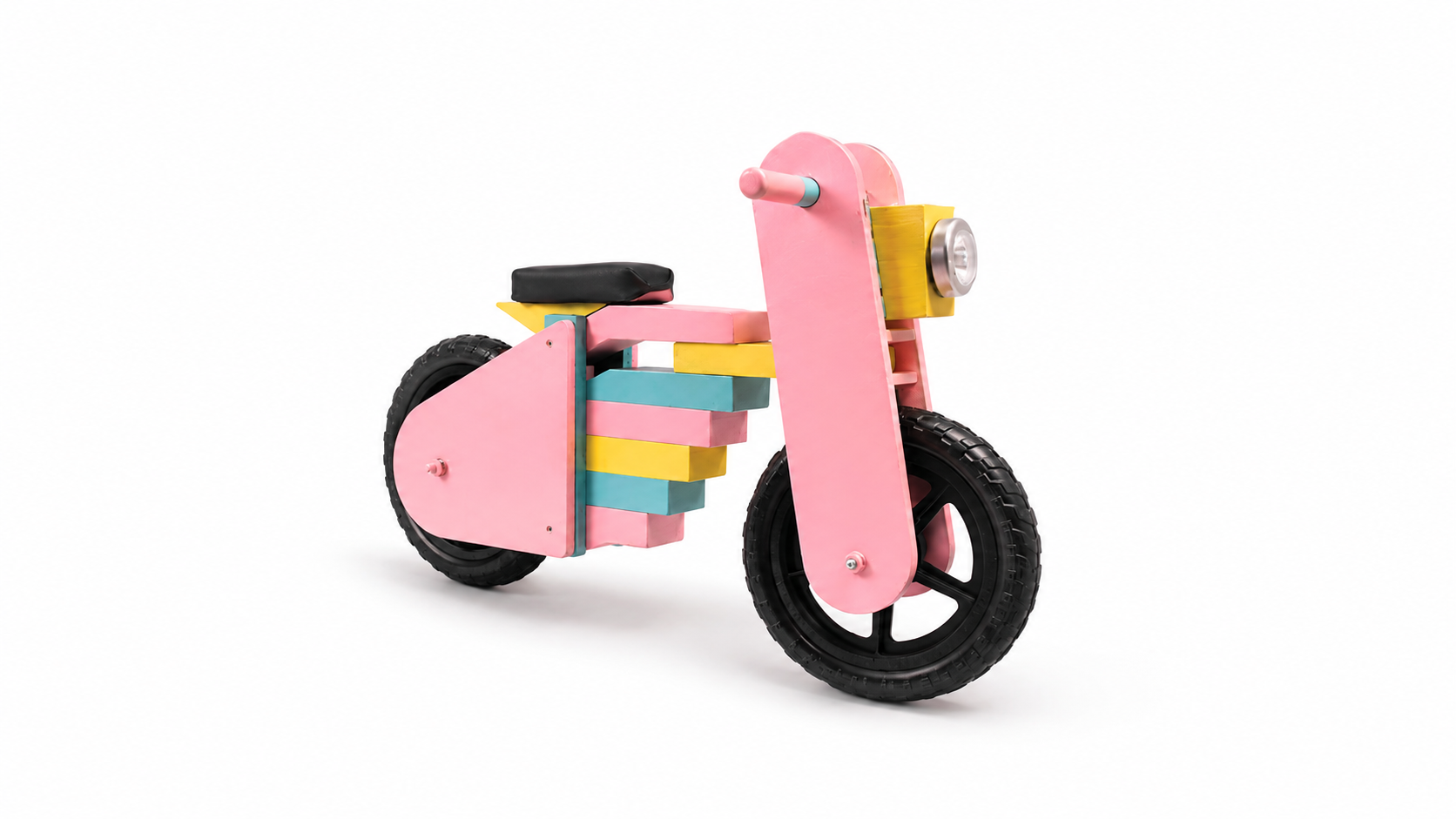
BALANCE BIKE – INSPIRED BY KUE LAPIS
This balance bike is a design project created by students of the Product Design Program, Faculty of Design and Creative Arts, Universitas Mercu Buana. Developed through an empathy-driven design approach, the project is designed to support children's physical, cognitive, and emotional development while embracing sustainability and environmental responsibility.

The design is inspired by kue lapis, a traditional Indonesian layered cake recognized for its distinctive colorful layers and strong cultural identity. This inspiration is translated into the bicycle through a layered frame structure and a harmonious palette of soft pastel colors. The composition creates a warm, cheerful, and inviting appearance, making the product visually engaging while introducing children to elements of local cultural heritage.

Beyond its aesthetic appeal, the layered concept symbolizes the gradual stages of a child's growth and learning journey. Just as each layer contributes to the cake's overall form, every riding experience helps children progressively develop balance, coordination, confidence, and independence. The sturdy frame construction ensures stability and safety, providing young riders with a secure and comfortable learning experience.

The principles of sustainability are reflected in the eflcient use of materials, durable construction, and a knockdown system that allows the bicycle to be easily assembled, disassembled, maintained, and transported. This modular approach reduces packaging volume, extends the product's lifespan through replaceable components, and minimizes material waste throughout its life cycle.

From an environmental perspective, the design prioritizes resource eflciency, ease of manufacturing, and recyclability without compromising functionality or aesthetics. By integrating empathy, cultural inspiration, sustainable design, and modular construction, this balance bike becomes more than a mobility product it is a meaningful learning companion that encourages children's development while celebrating Indonesian heritage through contemporary product design.

Creator: Ratu Tiara Jayaputri, Elizabeth Georgiana Pramitha, Elisabeth Antonia
Curatorial text: Junaidi Salam
BACA SELENGKAPNYA
KUE LAPIS BIKE

"WINGS BALL BIKE"

WINGS BALL BIKE – INSPIRED BY SPEED, ADVENTURE, AND IMAGINATION
The Wings Ball Bike is a balance bike concept created by students of the Product Design Program, Faculty of Design and Creative Arts, Universitas Mercu Buana. Developed through an empathy-driven design approach, the project is designed to support children's physical development while fostering imagination, confidence, and a sense of adventure. The design also integrates sustainability and environmental responsibility as key values throughout the product's life cycle.

The name Wings Ball Bike reflects the spirit behind the design. Wings symbolizes agility, freedom, and the feeling of soaring through exploration, inspired by the energetic movements of heroic adventure characters. Ball represents the imaginative and action-filled world of Japanese animation, encouraging creativity, curiosity, and playful storytelling. Bike identifies the product as a balance bicycle specifically designed to help young children develop essential riding skills.

These inspirations are translated into a dynamic frame with flowing lines, lightweight proportions, and sporty details that convey speed and movement while remaining approachable for children. The overall form creates an exciting visual identity that transforms the bicycle into more than a means of mobility it becomes a companion for imaginative play and discovery. The ergonomic geometry promotes comfort, stability, and balance, allowing children to build coordination and self-confidence naturally as they ride.

The principles of sustainability are incorporated through eflcient material utilization, durable construction, and a knockdown system that enables easy assembly, transportation, maintenance, and component replacement. This modular approach reduces packaging volume, extends product longevity, and minimizes material waste.

From an environmental perspective, the design emphasizes responsible manufacturing, eflcient resource use, and recyclability throughout the product's life cycle. By combining empathy, adventurous visual storytelling, sustainable design, and modular construction, the Wings Ball Bike delivers an engaging riding experience that inspires children to explore, imagine, and grow with confidence while promoting a more sustainable future.

Creator: Erik Rindan, Wahyu Ramadhani, Muhammad Rifaldi
Curatorial Text: Junaidi Salam
BACA SELENGKAPNYA
"WINGS BALL BIKE"

"CYBER FLOW BIKE"

CYBER FLOW BIKE – INSPIRED BY THE FLOW OF MOVEMENT AND CYBERPUNK AESTHETICS
The Cyber Flow Bike is a balance bike concept created by students of the Product Design Program, Faculty of Design and Creative Arts, Universitas Mercu Buana. Developed through an empathy-driven design approach, the project is designed to nurture children's physical development while encouraging creativity, confidence, and curiosity through expressive product aesthetics. At the same time, the design embraces sustainability and environmental responsibility as essential principles of contemporary product design.

The concept is inspired by the idea of flow continuous, seamless movement expressed through a frame that visually connects the front and rear sections with smooth, uninterrupted lines. The flowing geometry creates a sense of motion even when the bicycle is stationary, symbolizing children's natural energy, imagination, and freedom to explore. This dynamic form also contributes to an ergonomic structure that enhances stability, comfort, and balance during riding.

To reinforce its bold identity, the design adopts a Cyberpunk-inspired color palette featuring matte black, vibrant orange, neon pink, and electric purple. These contrasting colors create a futuristic and energetic visual language that stimulates children's imagination while giving the product a distinctive contemporary character. The combination of fluid forms and vibrant colors transforms the balance bike into more than a learning tool it becomes a playful expression of creativity and self-confidence.

The principles of sustainability are integrated through eflcient material utilization, durable construction, and a knockdown system that enables easy assembly, transportation, maintenance, and component replacement. This modular approach reduces packaging volume, extends the product's lifespan, and minimizes material waste.

From an environmental perspective, the design prioritizes resource eflciency, responsible manufacturing, and recyclability throughout the product's life cycle. By combining empathy, flowing biomorphic forms, futuristic aesthetics, sustainable design, and modular construction, the Cyber Flow Bike oVers an innovative riding experience that empowers children to explore, imagine.

Creator: Haikal Ikhwan Nurrohim, Khansa Miranda Farchan, Josua Calvin Hutabarat
Curatorial Text: Junadi Salam
BACA SELENGKAPNYA
"CYBER FLOW BIKE"

SCOOTER BIKE

BALANCE BIKE – INSPIRED BY THE CLASSIC SCOOTER
This balance bike is a design project created by students of the Product Design Program, Faculty of Design and Creative Arts, Universitas Mercu Buana. Developed through an empathy-driven design approach, the project addresses children's developmental needs while incorporating the principles of sustainability, environmental responsibility, and user-centered design.

The design is inspired by the timeless elegance of the classic scooter, an iconic form recognized for its distinctive silhouette and enduring appeal. Its frame adopts the characteristic features of vintage scooters, including smooth flowing curves, a rounded front profile, and balanced proportions that create a clean, simple, and sophisticated appearance. These elements are carefully reinterpreted into a child-friendly design that is approachable, playful, and visually engaging.

Beyond its nostalgic aesthetic, the classic scooter serves as a symbol of freedom, exploration, and joyful mobility. By translating these qualities into a balance bike, the design encourages children to develop confidence, independence, and curiosity as they learn fundamental riding skills. The ergonomic frame geometry provides comfort and stability, allowing young riders to improve their balance and coordination in a safe and enjoyable way.

The concept of sustainability is realized through eflcient material utilization, durable construction, and a knockdown system that enables easy assembly, disassembly, maintenance, and transportation. This modular construction reduces packaging volume, simplifies component replacement, and extends the product's lifespan while minimizing material waste.

From an environmental perspective, the design prioritizes manufacturing eflciency, resource conservation, and recyclability throughout the product's life cycle. By combining empathy, classic design heritage, sustainable thinking, and modular construction, this balance bike oVers a meaningful riding experience that blends timeless aesthetics with contemporary values, creating a functional, environmentally responsible, and emotionally engaging product for children.

Creator: Octaviola Ayu Ramadhani, Novia Awika Putri, Fida Nailah
Curatorial Text: Junaidi Salam
BACA SELENGKAPNYA

SCOOTER BIKE

VANELLOPE BIKE

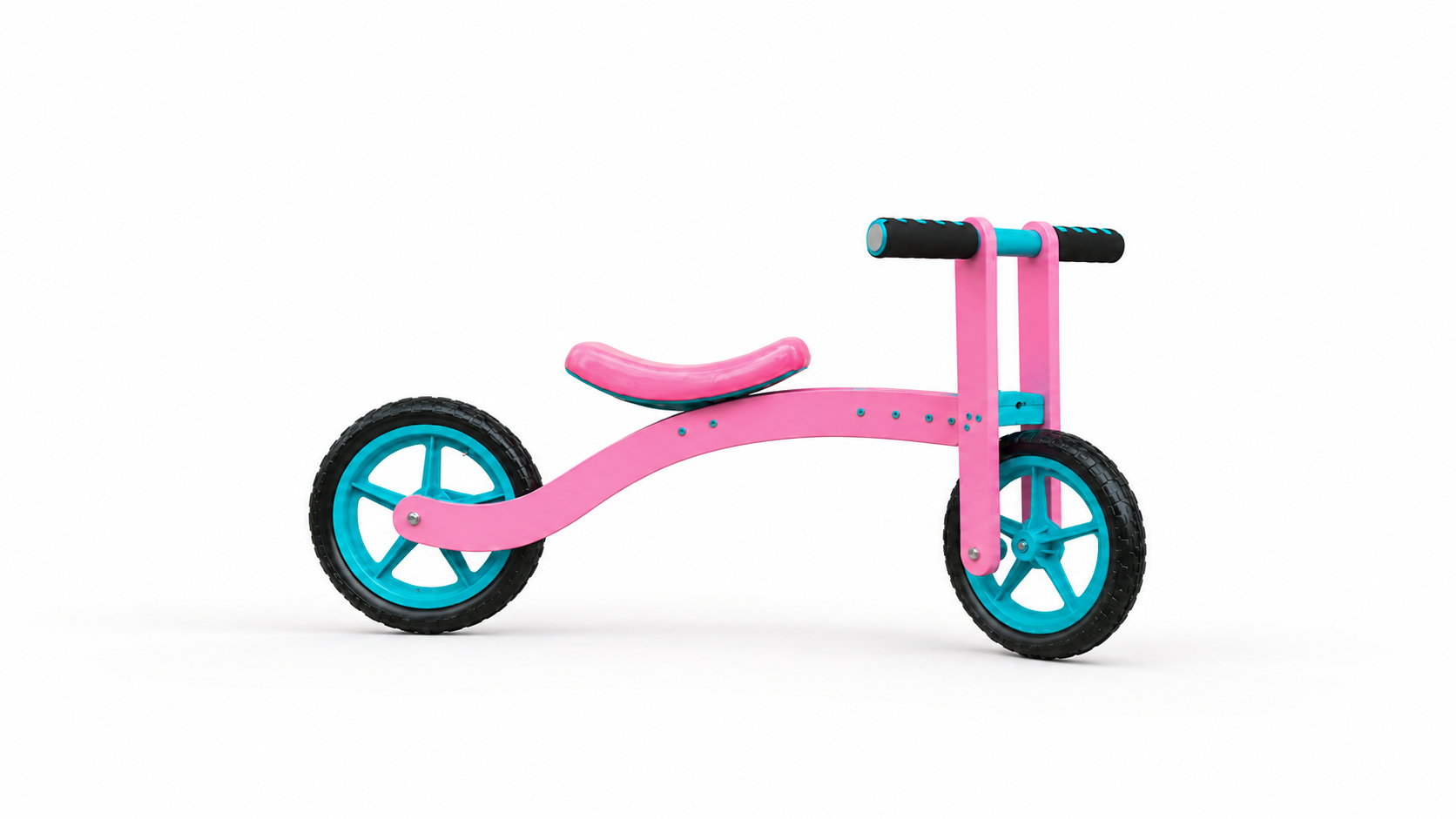
BALANCE BIKE – INSPIRED BY VANELLOPE
This balance bike is a design project created by students of the Product Design Program, Faculty of Design and Creative Arts, Universitas Mercu Buana. Developed through an empathy-driven design approach, the project focuses on children’s physical comfort, emotional engagement, safety, and developmental needs while integrating principles of sustainability and environmental responsibility.

The design is inspired by Vanellope, a cheerful, creative, and energetic character known for her playful personality and imaginative world. These qualities are translated into the bike’s visual appearance through a combination of mint green, pink, and colorful decorative accents resembling candy sprinkles. The selected color palette creates a sweet, playful, and imaginative impression that encourages children to interact with the product and enjoy the learning experience.

Simple geometric forms are combined with bright colors to create a distinctive, friendly, and contemporary appearance. The frame is designed with proportions that support comfort, stability, and ease of movement, helping children develop balance and confidence while riding. Its visual character also allows the product to function as both a learning tool and an expressive object that reflects children’s joyful personalities.

The concept of sustainability is implemented through eflcient material use, durable construction, and a knockdown system that enables the product to be assembled, disassembled, maintained, and transported more easily. This system reduces packaging volume and allows individual components to be replaced without discarding the entire product.

As a pedal-free balance bike, the design helps children develop coordination, motor skills, spatial awareness, and self-confidence before transitioning to a conventional bicycle. By combining empathy, playful character inspiration, modular construction, and sustainable design principles, this project oVers an enjoyable, functional, and environmentally responsible mobility product for children.

Creator: Amarulloh Bagus Rosyadi, Amelia Eka Puspita sari, Alifia Widyasaka
Curatorial Text: Junaidi Salam


BACA SELENGKAPNYA
VANELLOPE BIKE
×